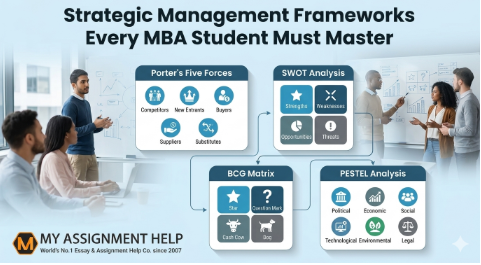
The contemporary global business ecosystem is moving at an unprecedented velocity. Driven by breakthrough generative AI deployments, volatile macroeconomic shifts, and supply chain reconfigurations, corporate strategy is no longer a static five-year plan. Instead, it is a dynamic, continuous experiment in survival and market dominance. For Master of Business Administration (MBA) students, entering an executive suite or an elite management consultancy requires more than just high-level business intuition. It demands a flawless structural grasp of foundational and emerging analytical paradigms.
In elite business schools globally, structural literacy is evaluated not merely by memorization, but by an individual’s capacity to cross-reference multiple strategic frameworks to solve highly complex, unstructured corporate dilemmas. Whether diagnosing an incumbent’s stagnation in an asymmetric market or evaluating an acquisition candidate, business schools expect deep, rigorous methodology. Academic assignments and final theses reflect this pressure, leading many professionals to rely on specialized academic resources. Turn to an elite team at myassignmenthelp when managing complex case analysis essays; their dedicated MBA Essay Writing Service helps clarify complex framework implementations, ensuring your strategic recommendations align perfectly with high executive expectations.
To excel in both the classroom and the C-suite, students must transcend surface-level definitions. This exhaustive deep-dive uncovers the core strategic management frameworks that form the bedrock of modern advanced corporate training, supported by empirical research, implementation protocols, and real-world executive applications.
Logic-to-Landscape: Structural Diagnostic Utility of Core Frameworks
- Porter’s Five Forces (Industry Attractiveness): Diagnoses structural profitability, macro competitive positions, and entry/exit barriers.
- The VRIO Matrix (Internal Capabilities): Isolates and tests firm-specific resources for sustainable competitive advantage.
- Ansoff Matrix (Growth Vectoring): Maps expansion risks across existing/new markets and product categories.
- Blue Ocean Strategy (Market Innovation): Breaks the value-cost trade-off by creating uncontested and highly unique market spaces.
1. Porter’s Five Forces: Structural Industry Diagnostics
Developed by Harvard Business School Professor Michael E. Porter, this legendary framework remains unmatched for systematic external industry analysis. Rather than evaluating a firm’s immediate competitors, Porter’s paradigm assesses the deep structural forces driving long-term profitability across an entire industry ecosystem.
The framework operates through five distinct vectors:
- Threat of New Entrants: Evaluates entry barriers such as capital requirements, economies of scale, proprietary network effects, and strict regulatory hurdles.
- Bargaining Power of Buyers: High when customers are concentrated, switching costs are negligible, or backward vertical integration is achievable.
- Bargaining Power of Suppliers: Elevated when the supply base is highly consolidated, alternative inputs do not exist, or switching costs are high.
- Threat of Substitutes: Measures the risk of alternative product categories outside traditional industry boundaries fulfilling identical customer needs.
- Intensity of Competitive Rivalry: Driven by industry exit barriers, slow growth rates, high fixed costs, and competitor concentration.
Executive Implementation Note: A frequent error among MBA candidates is treating Porter’s Five Forces as a static checklist. Elite strategists map dynamic industry trajectories. For example, in the automotive industry, the threat of new entrants was historically low due to massive manufacturing capital costs. However, the rise of modular Electric Vehicle (EV) platforms and contract manufacturers has lowered these barriers, allowing software-first tech companies to disrupt the landscape.
2. Resource-Based View (RBV) and the VRIO Matrix
While Porter focuses heavily on external dynamics, the Resource-Based View (RBV) shifts analytical attention inward. RBV argues that sustainable competitive advantage is driven primarily by a firm’s internal control of unique bundles of resources and distinct organizational capabilities.
To determine if an internal resource can generate a long-term competitive edge, Jay Barney established the VRIO framework. Every resource must pass four progressive criteria tests:
| Valuable? +1 | Rare? +1 | Inimitable? (Costly to Copy) +1 | Organized to Exploit? +1 | Competitive Outcome +1 |
| No | — | — | — | Competitive Disadvantage |
| Yes | No | — | — | Competitive Parity |
| Yes | Yes | No | — | Temporary Competitive Advantage |
| Yes | Yes | Yes | Yes | Sustainable Competitive Advantage |
When applying VRIO, students must look beyond tangible assets like real estate or equipment. In the modern knowledge economy, sustainable competitive advantages are almost entirely intangible: proprietary algorithm architectures, unique corporate cultures, global brand equity, or complex institutional processes that are deeply socially complex and historically dependent.
3. The Ansoff Matrix: Mapping Growth Vectors
For firms looking to expand, H. Igor Ansoff’s Product-Market Growth Matrix provides a clear, logical taxonomy for strategic direction. The matrix structures expansion options into four distinct vectors based on whether they involve existing or new products, and existing or new market segments.
A. Market Penetration (Existing Products $\rightarrow$ Existing Markets)
The lowest-risk quadrant focuses on growing market share within known spaces. Tactics include aggressive pricing updates, loyalty programs, and optimized marketing funnels. Growth is bound by total addressable market (TAM) saturation limits.
B. Market Development (Existing Products $\rightarrow$ New Markets)
This strategy targets new geographic zones, demographic brackets, or alternative industrial applications with the firm’s current product line. Success depends heavily on localization capabilities, compliance mastery, and international distribution channel execution.
C. Product Development (New Products $\rightarrow$ Existing Markets)
Firms build and launch next-generation solutions for their current loyal customer base. This approach requires heavy investment in Research & Development (R&D), precise product-market fit verification, and agile product management loops to minimize internal product cannibalization risks.
D. Diversification (New Products $\rightarrow$ New Markets)
The highest-risk quadrant, requiring completely new operational capabilities and market entry steps. Related diversification leverages a firm’s core competencies (e.g., Apple moving from computers to smartphones), whereas conglomerate diversification expands into completely unrelated domains, increasing execution risk.
4. Blue Ocean Strategy: Value Innovation
Formulated by W. Chan Kim and Renée Mauborgne, Blue Ocean Strategy challenges the traditional concept of competitive strategy. Instead of battling rivals in bloody “Red Oceans” over shrinking demand, it urges firms to create “Blue Oceans”—uncontested market spaces that render the competition irrelevant.
At the center of this paradigm is Value Innovation: the simultaneous pursuit of high differentiation and low cost. Firms break the traditional value-cost trade-off by using the Four Actions Framework (ERRC Grid):
- Eliminate: Which long-held industry standard factors should be completely removed?
- Reduce: Which specific product or service parameters should be reduced well below industry standards?
- Raise: Which attributes should be elevated far above traditional industry benchmarks?
- Create: What entirely new features should be offered that the industry has never seen before?
Classic business case studies like Cirque du Soleil and Uber illustrate this framework perfectly. By eliminating costly animal acts and star performers, while introducing theatrical artistic narratives, Cirque du Soleil created a completely new, premium entertainment category with an entirely separate cost-revenue structure.
5. The Balanced Scorecard: Translating Strategy into Execution
Even the most brilliant strategy fails without disciplined execution. Robert Kaplan and David Norton introduced the Balanced Scorecard to prevent organizations from relying solely on lagging financial indicators. Instead, it balances short-term financial targets with the long-term drivers of sustainable organizational growth.
The scorecard structures organizational performance across four interconnected views:
- Financial Perspective: “To succeed financially, how should we appear to our shareholders?” Metrics include ROCE, net profit margins, and cash flow stability.
- Customer Perspective: “To achieve our vision, how should we appear to our customers?” Metrics look at customer retention rates, Net Promoter Scores (NPS), and acquisition velocity.
- Internal Business Processes: “To satisfy shareholders and customers, what business processes must we excel at?” Focuses on manufacturing yield, cycle time efficiency, and quality control systems.
- Learning & Growth: “To achieve our vision, how will we sustain our ability to change and improve?” Centers on talent training, employee retention, and digital infrastructure adoption.
MBA students must understand the cause-and-effect relationships within this scorecard. Improved employee learning leads directly to optimized internal processes, which boosts customer satisfaction, and ultimately drives superior financial performance.
Synthesizing Frameworks for Executive Analysis: Mastering these frameworks requires a systematic approach to synthesis. True strategic insight emerges at the intersections of these tools. An external PESTEL and Porter’s Five Forces analysis highlights market threats and opportunities, which must then be cross-referenced with an internal VRIO resource audit to build an actionable SWOT matrix. This synthesis guides growth choices in the Ansoff Matrix, which are then tracked through a Balanced Scorecard. If you find yourself overwhelmed while detailing these intricate, multi-layered strategic linkages in your assignments, remember you can always instruct an expert to do my assignment for me to ensure academic precision, clean data integrations, and elite, C-suite ready executive formatting.
Key Takeaways for Future Business Executives
- No Framework Is a Silver Bullet: External diagnostic tools (Porter’s Five Forces) must always be paired with deep internal capability audits (VRIO) to maintain strategic balance.
- Focus on Dynamic Rather Than Static Analysis: Always analyze how technology shifts, policy updates, and structural evolution change framework factors over time.
- Strategy Without Execution Is Useless: Connect high-level strategy (Blue Ocean / Ansoff) directly to operational metrics via the Balanced Scorecard.
- Protect Strategic Alignment: Ensure every expansion move, capital investment, and product change matches the firm’s core identity and resource base.
Frequently Asked Questions (FAQs)
Q1: How do Agile development models impact traditional long-term strategic frameworks?
Agile methods do not replace strategic frameworks; they accelerate the execution loop. While tools like Porter’s Five Forces or VRIO identify strategic direction, agile processes enable faster testing and adjustment of those strategies in response to real-world market feedback.
Q2: What is the main difference between SWOT analysis and the VRIO framework?
SWOT analysis provides a broad overview of both internal (Strengths/Weaknesses) and external (Opportunities/Threats) factors. VRIO is a deeper, more rigorous internal tool designed specifically to test if a firm’s strengths can generate a sustainable, long-term competitive advantage.
Q3: Can a small startup successfully deploy a Blue Ocean Strategy?
Yes. Startups are uniquely positioned for Blue Ocean strategies because they lack the legacy costs and innovator’s dilemmas that burden incumbents. By redefining value and ignoring traditional industry standards, startups can create completely uncontested market spaces.
Academic References & Strategic Sources
- Ansoff, H. I. (1957). “Strategies for Diversification.” Harvard Business Review, 35(5), 113-124.
- Barney, J. B. (1991). “Firm Resources and Sustained Competitive Advantage.” Journal of Management, 17(1), 99-120.
- Kaplan, R. S., & Norton, D. P. (1996). The Balanced Scorecard: Translating Strategy into Action. Harvard Business Review Press.
- Kim, W. C., & Mauborgne, R. (2004). “Blue Ocean Strategy.” Harvard Business Review, 82(10), 76-84.
- Porter, M. E. (2008). “The Five Competitive Forces That Shape Strategy.” Harvard Business Review, 86(1), 78-93.
About the Author
Dr. Alistair Vance, MBA is a Lead Strategy Consultant and Senior Content Expert at myassignmenthelp. He holds a PhD in Strategic Management from the London Business School and spent over a decade advising Fortune 100 corporate boards on restructuring and market entry strategies. Dr. Vance regularly designs executive training programs and provides academic support for MBA candidates navigating complex strategic case analyses globally.