The Rise of AI Female Generator: Why Creators Are Ditching the Recording Booth
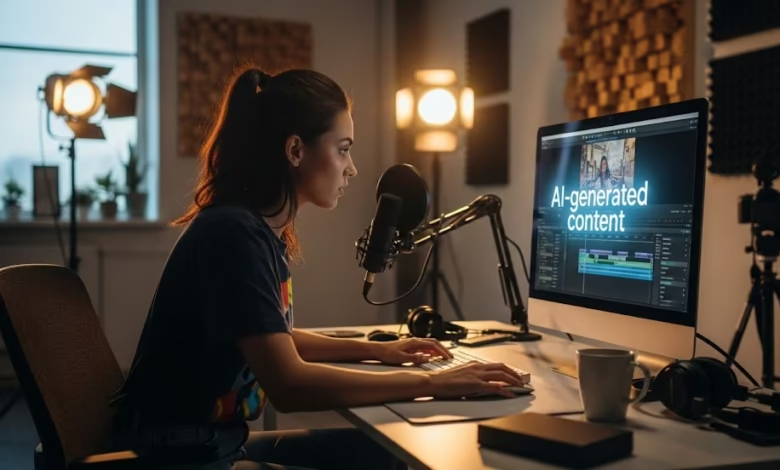
There’s a moment every content creator knows well — you’ve finished writing a script, the visuals are ready, and then you hit the wall: you need a voice.
Booking a voice actor takes days. Recording yourself means equipment, editing, and more time you don’t have. And if the voice doesn’t sound right for the project, you start over.
This is exactly why AI voice generation has gone from a novelty to a genuine production tool. More specifically, the demand for a reliable female voice generator has grown steadily among podcasters, educators, game developers, and video creators who need natural-sounding female speech — on demand, without a studio.
What Makes a Female AI Voice Actually Usable?
Not all text-to-speech tools are created equal. The early generation of AI voices were recognizable by their flat delivery, unnatural pauses, and that unmistakable robotic quality that made listeners tune out. The gap between “technically voice” and “actually listenable” was significant.
What’s changed is the ability to control emotion.
A modern female voice generator doesn’t just read text aloud — it interprets the content. Selecting a “calm” mode produces a different cadence and warmth than selecting “assertive” or “cheerful.” The same sentence sounds entirely different depending on the emotional context you assign to it. That’s the shift that makes AI voices genuinely useful for storytelling, not just utilitarian text readout.
30+ Voices Is More Useful Than It Sounds
Having a range of voice options matters more than most people initially expect.
A meditation guide needs something different from a product explainer. A game character voice needs to feel distinct from a documentary narrator. A children’s e-learning module calls for energy that a corporate training video doesn’t.
The female voice generator includes over 30 distinct female voices — spanning ages, personalities, and delivery styles. There are voices described as “Wise Lady,” “Playful Girl,” “Confident Woman,” “Soft-spoken Girl,” and more. Each has its own texture. Each previews before you commit, which is a small detail that saves a lot of time in practice.
This variety also matters for multilingual work. The tool auto-detects input language, so switching between English, Spanish, or French content doesn’t require reconfiguring anything — the female voice adjusts automatically.
Emotion Control: The Feature That Changes the Output
If there’s one capability that separates a genuinely useful female voice generator from a basic TTS tool, it’s emotion control.
Paste the same paragraph into any standard text-to-speech engine, and you get one output. With emotion modes — calm, happy, sad, angry, fearful, surprised, neutral — you’re not just adjusting the voice, you’re adjusting the performance. Pacing shifts. Emphasis lands differently. The result sounds like a choice was made, not just a sentence was processed.
For game developers, this is especially practical. A character that sounds “angry” and a character that sounds “fearful” require two completely different voice performances. Being able to generate both from the same voice with an emotion toggle — rather than booking separate recording sessions — changes how solo developers and small studios approach audio production entirely.
Real Use Cases Worth Knowing About
Podcasters producing long-form content use AI female voices to handle segments when hosting solo feels repetitive, or to create a second “narrator” voice for scripted episodes. The output is clean enough for professional audio without post-processing.
YouTube creators running channels in niches like meditation, ASMR, or educational content have found that soft, warm female AI voices are often preferred by their audiences — and the ability to generate those voices instantly means they can publish on a faster schedule.
Marketers testing ad scripts use a female voice generator to produce multiple voice variations before committing to a final recording. Testing three different emotional tones costs nothing when you can generate them in seconds.
E-commerce brands use consistent AI voiceovers across large product catalogs to maintain brand tone — something impractical to do with human voice actors at scale.
The Practical Reality: Free, No Account, No Friction
One of the quietly important things about aidubbing.io’s female voice generator is what it doesn’t ask for. No account creation. No credit card. No free trial with a usage ceiling that kicks in after five minutes.
You arrive, paste your text, pick a voice, and generate. That’s the entire workflow.
For creators who just want to test whether AI voice fits their project, this matters. Too many tools bury their actual quality behind a signup wall, only to disappoint once you’re in. Starting immediately removes that uncertainty.
A Note on What AI Voice Doesn’t Replace
It’s worth being honest: for projects where a unique vocal identity is central — a branded podcast, a documentary with a specific narrator personality, a commercial that lives or dies on performance — human voice talent still has qualities that AI hasn’t fully replicated.
But that’s a narrow slice of the work most creators actually need done. For tutorials, explainers, game dialogue, product narration, social content, audiobooks, and e-learning, a well-chosen AI female voice is indistinguishable from professional recorded audio to most listeners. The gap has closed faster than people expected.
Conclusion
The question of whether AI female voices are “good enough” has been quietly settled by the people who use them every day. Podcasters keep using them. Game studios keep building with them. Content teams keep publishing with them.
What a good female voice generator gives you isn’t just a voice — it’s the ability to move forward without waiting, without booking sessions, and without compromising on quality. The combination of voice variety, emotion control, and multilingual support in one free, frictionless tool covers the needs of most modern creators.
If you’ve been putting off audio production because the voice piece felt like a bottleneck, it probably doesn’t have to be anymore.