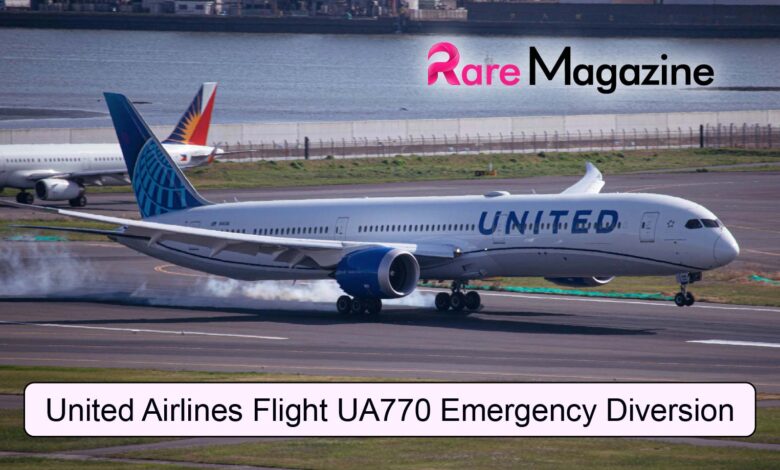
The United Airlines Flight UA770 emergency diversion occurred on May 27, 2025, while the aircraft was en route from Barcelona to Chicago, when the crew detected a cabin pressure system warning. To protect everyone on board, the pilots declared an emergency and diverted to London Heathrow, where the aircraft landed safely without injuries. The story made news around the world and became a clear example of how well modern aviation systems manage risk. Many people watched the diversion live on popular flight-tracking websites, which increased public attention and concern even before the aircraft landed. This article explains what happened, why the diversion occurred, and what travelers can learn from it.
Flight UA770 Overview
United Airlines Flight UA770 is a regular long-haul service that connects Barcelona El Prat Airport in Spain with Chicago O’Hare International Airport in the United States. It usually takes about 9 to 10 hours and crosses a large part of Europe and the North Atlantic.
On the day of the United Airlines Flight UA770 Emergency Diversion, the flight was operated by a Boeing 787-9 Dreamliner, registered as N26902, a modern wide-body jet designed for long international routes. Reports state that there were around 257 passengers and 12 crew members on board, so more than 260 people were depending on the aircraft and crew to keep them safe.
Basic Facts: Quick Summary
| Detail | Information |
|---|---|
| Airline | United Airlines |
| Flight Number | UA770 |
| Route | Barcelona (BCN) to Chicago (ORD) |
| Aircraft Type | Boeing 787-9 Dreamliner (Reg. N26902) |
| Date of Incident | May 27, 2025 |
| Diversion Airport | London Heathrow (LHR) |
| People on Board | About 257 passengers, 12 crew |
| Outcome | Safe landing, no injuries reported |
You May Also Read: Delta Flight DL275 Diverted LAX: Cause and What Happened
What Happened on Flight UA770?
Flight UA770 departed Barcelona in the afternoon and climbed normally to its cruising altitude of about 37,000 feet. For some time, the flight was routine. Passengers settled in for the long journey, and the crew followed standard procedures.
Around 90 minutes after takeoff, the flight crew noticed something unusual on their instruments. Indications from the cabin pressure system suggested that something might not be working correctly. There was no explosive decompression, and passengers did not report any sudden physical change, but the readings were serious enough that they could not be ignored.
The pilots began to follow their checklists. They watched the instruments, confirmed what they were seeing, and spoke with airline operations and air traffic control. Even at this stage, the main goal was simple: stay ahead of the problem and keep everyone safe.
Cabin Pressure Warning Explained
A modern jet like the Boeing 787 flies far higher than humans can safely breathe without help. Outside air at 37,000 feet is very thin. The cabin pressurization system keeps the aircraft’s interior at a much lower “cabin altitude,” similar to a mountain town, so passengers can sit comfortably without oxygen masks.
If this system shows abnormal readings, it does not always mean that the cabin will suddenly lose pressure. Sometimes it may be a sensor issue or a minor problem that never grows. However, pressurization affects every person on the aircraft. For that reason, any warning tied to cabin pressure is treated with great care.
In the United Airlines Flight UA770 Emergency Diversion, reports say that the crew saw a cabin pressurization alert in the cockpit. The cabin itself remained stable, and passengers did not experience significant physical effects, but the system was indicating to the pilots that something might be wrong behind the scenes. The safest choice in such a case is not to wait and see. It is to act early.
Why Pilots Sent the 7700 Emergency Code
Once the crew confirmed that the warning was genuine and could affect safety, the captain declared a general emergency. In aviation, this is done by selecting a special code on the aircraft’s transponder. The code is 7700.
When a pilot “squawks 7700,” every air traffic controller watching that radar picture sees a clear emergency signal. It does not specify precisely what is wrong, but it makes clear that this aircraft needs priority in the air and on the ground.
On Flight UA770, entering this code meant controllers along the route knew at once there was an issue. It allowed them to clear other traffic, provide direct routes, and prepare emergency services at the chosen airport. To some passengers, hearing the word “emergency” may sound frightening. Still, in professional aviation, it often means the crew is using every tool available to keep the situation safe and under control.
The Decision to Divert the Flight
After declaring the emergency, the next question was where to land. The aircraft was already well into its journey away from Spain, heading toward the Atlantic. Continuing all the way to Chicago with a possible cabin pressurization problem would have meant many more hours in the air, much of it over the ocean.
The crew and airline operations looked at the map. They considered factors such as distance, weather, runway length, and the ability of airports to handle a wide-body jet in an emergency. The safest choice was to divert before the flight crossed deep ocean areas. That decision reflects a simple rule in aviation: never stretch a risky situation when a safer option is available.
Why London Heathrow Was Chosen
London Heathrow was chosen as the diversion airport for several compelling reasons. Located directly along the route between continental Europe and North America, it made sense given the aircraft’s position at the time. The airport’s long runways can accommodate fully loaded wide-body aircraft, and its extensive emergency and maintenance infrastructure, including teams experienced with the Boeing 787, make it a strong operational choice.
Heathrow is also one of the busiest and most prepared airports in Europe. Its emergency teams train regularly for unexpected landings, which makes it an ideal choice for an aircraft experiencing system warnings. Choosing Heathrow gave the crew access to tools, support, and resources that smaller airports may not have.
The Emergency Landing Process
Once London Heathrow was selected, air traffic control gave Flight UA770 a priority route and cleared other aircraft from its path. The pilots began a controlled descent from cruising altitude. There was no sudden dive. Instead, the descent followed standard emergency procedures meant to be safe and manageable for everyone on board.
Emergency vehicles were moved into position near the runway in case the pressurization problem worsened or created other issues during landing. Reports say that the Boeing 787-9 landed on Heathrow’s Runway 27R at about 4:55 p.m. local time and then taxied to Gate B44, where engineers and ground staff were waiting.
Most importantly, the landing was smooth and uneventful from a safety perspective. No injuries were reported among the passengers or crew. For an event that began with a cockpit alert, the result was a quiet arrival at a busy international airport.
Inside the Cabin: Passenger Experience
On board, the diversion felt very different from a routine flight, especially after the announcement. Passengers who had settled into movies, meals, or sleep suddenly heard that the flight would not continue to Chicago but would instead land in London due to an issue with the aircraft’s systems.
Understandably, many people felt nervous or confused. Some reports mention tense moments after the announcement, followed by a sense of relief when the aircraft touched down safely. Others later shared short messages online saying that the crew kept them calm and informed, which helped ease the tension.
However, passengers also noted that the cabin remained orderly. There were no scenes of panic or shouting. Most people stayed in their seats, followed instructions, and waited for the crew to guide them through the next steps once the aircraft reached the gate.
How the Crew Handled the Situation
The crew of Flight UA770 had trained for emergencies many times before this day. Pilots regularly practice scenarios such as system failures, pressurization warnings, and emergency descents in full-motion simulators. Cabin crew are trained in communication, crowd management, and first aid.
During the United Airlines Flight UA770 Emergency Diversion, these skills became real. The pilots stayed focused on navigation, system checks, and communication with air traffic control. Flight attendants walked through the cabin, checked seat belts, answered questions, and reassured worried passengers as best they could.
Many passengers later praised the calm tone of the announcements and the crew’s professionalism. Their actions turned a situation that could have been chaotic into one that was stressful but controlled.
How United Airlines Responded
After landing, United Airlines had two main tasks. The first was to ensure the aircraft was carefully inspected and kept on the ground until engineers understood what had happened. The second was to look after the people who were supposed to be on their way to Chicago.
Reports say that passengers were rebooked on later flights from Heathrow to Chicago or other final destinations. Those who had to wait were offered hotel stays, meal vouchers, and help with changed connections. Because the flight originated in Europe, some passengers also asked about their rights under EU or UK travel rules, which can sometimes offer compensation or expense coverage depending on the reason for the diversion.
United also had to manage the operational side. A diversion like this can disrupt crew schedules, aircraft rotations, and future flights that depend on the same airplane. Airlines usually adjust their schedules quickly to limit delays for other passengers, but these ripple effects are part of every unscheduled landing.
The airline released a public statement confirming that Flight UA770 had diverted due to a technical indication, stressing that safety was the top priority and that there were no injuries. They also stated that the aircraft would undergo a detailed technical review before returning to regular service.
What Investigators Checked on the Aircraft
Once the aircraft was parked and passengers were off, engineering teams began a thorough inspection. The primary focus was the pressurization system and related sensors, since that was where the cockpit warning had appeared.
On a Boeing 787-9, the environmental control system includes pressure controllers, valves, and multiple sensors that work together to regulate cabin pressure. Investigators would have examined these components, reviewed maintenance logs, and pulled data from the aircraft’s systems to determine exactly what the sensors recorded during the flight. This data often comes from systems like ACARS, which sends messages to airline operations, and Airplane Health Management (AHM) tools that monitor the jet’s condition in real time.
If any parts showed clear faults or suspicious behavior, they would be replaced or repaired. Even if the incident turned out to be a false alarm from a single sensor, engineers would still treat it seriously, because the goal is always to reduce the chance of similar warnings in the future. At the time of writing, the exact technical root cause has not been publicly confirmed.
Understanding Emergency Diversions
The United Airlines Flight UA770 Emergency Diversion is just one example of an event that happens from time to time in aviation. An emergency diversion means that a flight changes its planned destination to another airport for safety reasons. It can be due to technical issues, medical emergencies, weather changes, or security concerns.
To passengers, it often feels dramatic because it breaks the usual rhythm of a flight and brings up thoughts of danger. But in practice, diversions are one of the main tools that keep flying safe. They allow pilots to shorten the time between a possible problem and a safe landing.
In most cases, diversions like UA770 end the same way: the aircraft lands safely, the issue is checked on the ground, and passengers arrive late but unharmed.
Safety Features of the Boeing 787
The Boeing 787-9 Dreamliner is known for its modern design and advanced systems. It uses computers to monitor many aircraft systems in real time, including the engines, electrical systems, and pressurization. These systems can send information to the airline’s operations center through technology such as ACARS. At the same time, tools like ADS-B share the aircraft’s location and altitude with air traffic control and even public tracking websites.
The Dreamliner also has layers of redundancy, which means that if one part fails, another can often take over. This design does not mean that issues never happen. Instead, it means that when something starts to go wrong, the aircraft and crew have more options to keep the flight safe. In the case of Flight UA770, the pressurization alert was a sign that the safety systems were doing their job: detecting an anomaly and prompting the crew to take action.
How Air Traffic Control Helps During Emergencies
Air traffic controllers played a significant role in ensuring the safe outcome of United Airlines Flight UA770’s Emergency Diversion. As soon as the 7700 code appeared on their screens, they knew that this aircraft required special handling.
Controllers along the route worked together to provide the Boeing 787-9 with a direct path to London. They cleared nearby aircraft from its altitude and route, provided updated weather and runway information, and made sure emergency services at Heathrow were ready in advance. In Europe, organizations such as EUROCONTROL help coordinate this kind of cross-border response when flights move quickly between countries.
This teamwork between the cockpit and the control centers is one reason why even unexpected events can be handled without confusion.
Why No Oxygen Masks Deployed
Many people associate pressurization problems with oxygen masks dropping from the ceiling. That happens in cases of rapid decompression, when the air inside the cabin suddenly becomes too thin to breathe safely.
On Flight UA770, there was a warning about the pressurization system, but there was no report of a sudden loss of cabin pressure. The system may have stayed within safe limits while still showing abnormal behavior on the flight deck instruments. In such a case, oxygen masks do not automatically deploy because passengers are still breathing safe air.
This difference can be confusing from the outside. The key point is that the crew acted before the situation reached a more serious stage. That early action is exactly what safety training is designed to produce.
What the FAA and Authorities Will Review
Whenever a flight declares an in-air emergency and diverts, aviation authorities expect a clear record of what happened. In this case, United Airlines would share data with the U.S. Federal Aviation Administration (FAA) and European regulators, since the diversion occurred in UK airspace after departure from Spain. The National Transportation Safety Board (NTSB) may also review the incident depending on the findings, especially because it involved a U.S.-registered aircraft.
Investigators review several types of information, starting with flight data that captures altitude, speed, system readings, and crew actions. They also examine maintenance logs to determine whether the aircraft has shown similar warnings in the past. Cockpit voice recordings may be analyzed as well to understand how the crew responded in real time.
Based on this review, authorities decide whether the event was an isolated technical issue or a sign of a broader pattern that might require attention. If they see something that could affect other aircraft or operators, they can issue safety recommendations. These might include closer checks of specific components, software updates, or changes to inspection schedules. Over time, this process helps make future flights safer, not just for United but for the entire industry.
Expert Views on the Incident
Aviation safety experts who have commented on the United Airlines Flight UA770 Emergency Diversion often describe it as a “textbook” case. They point out that the crew chose to act early, rather than wait for the problem to get worse. They praise the effective coordination between the airline’s operations center, air traffic control, and the airport emergency teams.
Some experts also note that this incident shows how modern aircraft technology and human decision-making support one another. The systems on the Boeing 787 detected an irregularity. The pilots understood what those warnings meant and used their training to make a conservative, safety-first choice. The result was a safe landing and an important learning opportunity, rather than a serious accident.
Key Lessons from Flight UA770
Flight UA770 teaches several quiet but powerful lessons. One is that an emergency declaration does not mean that an aircraft is out of control. It often means the opposite: the crew is fully in control and is using every available support to reduce risk.
Another lesson is the value of clear communication. Passengers later said that hearing honest updates and calm explanations helped them stay composed. For airlines, this is a reminder that safety is not only about systems and procedures, but also about how people are guided through stressful moments.
Finally, the incident shows the strength of today’s safety culture. The aircraft did not continue to its planned destination because someone wanted to “save the schedule.” Instead, it changed course to protect the people on board. That choice caused delays and cost money, but it protected lives, which is always the highest priority.
What Travelers Should Know About Flight Safety
For travelers in the United States and around the world, the United Airlines Flight UA770 Emergency Diversion may look worrying at first glance. A closer look, however, gives a different message.
The incident highlights how modern aircraft are equipped with sensors designed to detect even minor irregularities. It also shows that pilots and cabin crew spend years training for situations they may never face, just in case they do one day. Finally, it demonstrates how major airports like London Heathrow can respond at a moment’s notice to accommodate an unexpected wide-body jet and support hundreds of passengers and crew who did not plan to land there.
It also shows that diversions are a normal, built-in part of aviation safety. Other United flights in past years, such as UA769 and UA673, have also diverted due to weather or medical issues, reminding travelers that diversions are not signs of danger. They are signs of trained crews choosing the safest path.
Most flights will never experience anything like UA770. But if one does, this incident suggests that aviation’s systems and personnel are ready to respond.
You May Also Read: Dihward: The Complete Guide to Meaning, Mindset, Technology and Future Innovation
Conclusion
The story of the United Airlines Flight UA770 Emergency Diversion is not a story of disaster. It is a story of caution, technology, and professionalism. A routine long-haul flight from Barcelona to Chicago developed a possible pressurization issue at 37,000 feet. The crew declared an emergency, diverted to London Heathrow, and landed safely. No one was hurt.
For airlines and regulators, the incident offers data and lessons that can improve safety even further. For travelers, it serves as a reminder that when something unusual happens in the air, the most likely outcome is still a safe arrival, backed by layers of systems, training, and teamwork that most people never see.
In the end, Flight UA770 shows that the real goal of aviation is not just to keep flights on time. It is to make sure that, no matter what happens, everyone comes home.
FAQs About United Airlines Flight UA770 Emergency Diversion
What caused the United Airlines Flight UA770 Emergency Diversion?
Flight UA770 diverted after the crew received a warning linked to the cabin pressure system. The cabin stayed stable, but the alert required a quick safety decision. The pilots chose to land early as a precaution.
Why did the pilots declare a 7700 emergency code?
The 7700 code is used when a flight needs priority handling. The crew sent this code, so air traffic control could clear airspace, guide the aircraft directly to a safe airport, and prepare emergency support.
Why was London Heathrow chosen for the emergency landing?
Heathrow was the closest major airport with long runways, strong emergency services, and teams trained to handle wide-body jets. It offered the safest and fastest landing option.
Did oxygen masks drop during the United Airlines Flight UA770 Emergency Diversion?
No. The warning showed a possible issue, but there was no sudden loss of cabin pressure. Because the cabin air remained safe, the oxygen masks did not deploy.
Were any passengers or crew injured during the diversion?
No injuries were reported. The landing was smooth, and everyone on board left the aircraft safely.
What happened to the passengers after the emergency landing?
United Airlines rebooked passengers on later flights and provided meals, hotels, or other support when needed. Most travelers reached their final destinations the same day or the next.
What did investigators check on the aircraft after landing?
Engineers examined the pressurization system, sensors, data logs, and related components. They also reviewed flight records to confirm what triggered the warning before the jet returned to service.
What does the United Airlines Flight UA770 Emergency Diversion teach travelers about flight safety?
It shows that safety systems work as designed. Early warnings, trained crews, and strong airport support help prevent minor technical issues from becoming serious. Diversions like this are rare but essential for keeping passengers safe.
You May Also Read: Jyokyo Meaning Explained: The Life-Changing Japanese Concept You Need to Know
For More Information Visit: Rare Magazine