What Is SIEM and How It Centralises Security Visibility
Every enterprise network produces a constant stream of telemetry: firewall logs, authentication records, application events, endpoint activity, cloud service logs. Each of these data streams, viewed in isolation, tells a narrow story. A login event by itself says little. A spike in outbound traffic by itself says little. But when these scattered signals are brought together and examined as a whole, patterns emerge that no single data source could reveal on its own.
This is the fundamental problem that security information and event management, or SIEM, was built to solve. Before centralized log aggregation became standard practice, security teams faced a frustrating reality: the evidence needed to detect a threat often existed somewhere in the environment, but it was scattered across dozens of disconnected systems, each with its own format, its own retention policy, and its own interface.
What SIEM Actually Does
At its core, a SIEM platform performs two related functions: it collects security-relevant data from across the enterprise environment into a single repository and analyzes that data to identify patterns indicating potential threats. SIEM for centralising security event data achieves this by ingesting logs and events from firewalls, servers, endpoints, applications, cloud platforms, and identity systems, normalizing that data into a consistent format, and storing it in a way that makes it searchable and correlatable.
The normalization step matters more than it might initially seem. Different systems log events in wildly different formats. A firewall might log a blocked connection one way, while an authentication system logs a failed login attempt in an entirely different structure. Without normalization, comparing or correlating these events would require manually reconciling incompatible data formats whenever an analyst wanted to investigate something spanning multiple systems. SIEM platforms handle this translation automatically, converting disparate log formats into a common structure that supports unified search and analysis.
Once data is centralized and normalized, the SIEM applies correlation rules and analytics to identify patterns that might indicate malicious activity. A single failed login attempt is unremarkable. Fifty failed login attempts against the same account within a minute, followed by a successful login from an unfamiliar location, is a pattern worth investigating. SIEM platforms are designed to surface exactly this kind of pattern, which would be effectively invisible if each data source were reviewed independently.
Why Centralized Visibility Changes Detection Capability
The value of centralizing security visibility becomes clearest when considering how threats actually unfold across modern enterprise environments. A sophisticated attack rarely confines itself to a single system. An attacker might gain initial access through a phishing email, move laterally through the network using compromised credentials, and ultimately exfiltrate data through a cloud storage service. Each of these stages generates evidence in a different part of the environment.
Without centralized visibility, detecting this kind of multi-stage attack requires an analyst to manually piece together evidence from email security logs, network logs, identity logs, and cloud access logs, recognizing the connection between events that, viewed individually, might each seem like minor anomalies. This manual correlation is slow, requires significant expertise, and is prone to missing connections that are not immediately obvious.
A SIEM platform performs this correlation automatically and continuously. Because all the relevant data already exists within the same searchable repository, the platform can identify when events across different systems share a common thread, such as the same user account, the same IP address, or the same file hash, and surface that connection to analysts as a unified incident rather than a collection of disconnected alerts.
The Operational Value of a Single Source of Truth
Beyond improving detection capability, centralized security visibility delivers practical operational benefits that matter to security teams managing day-to-day work. When an incident occurs, having a single, searchable repository of security data dramatically reduces the time required to investigate. An analyst can search across the entire environment from one interface rather than navigating between multiple disconnected tools, each requiring separate access and separate query syntax.
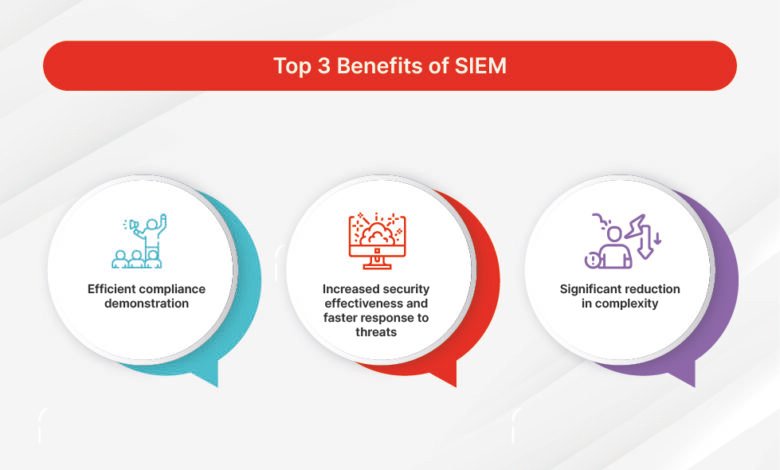
This consolidation also supports compliance and audit requirements more effectively. Many regulatory frameworks require organizations to demonstrate that they monitor security events and can produce records of relevant activity over defined retention periods. A centralized SIEM repository provides exactly this kind of consistent, auditable record, rather than requiring an organization to reconstruct an audit trail from multiple disparate log sources after the fact.
Dashboards and reporting built on top of centralized data also give security leaders a more accurate picture of the organization’s overall security posture. Rather than relying on summaries from individual tool vendors, leadership can see aggregated metrics drawn directly from the actual event data flowing through the environment.
Centralization as a Foundation for Broader Security Operations
SIEM’s role in centralizing visibility also makes it foundational to other security operations functions. Security orchestration, automation, and response platforms typically rely on the SIEM as their primary source of alert data, since the SIEM has already done the work of aggregating and correlating raw events into meaningful alerts. Threat hunting activities depend on having a rich, centralized dataset to search through when looking for indicators that automated detection rules have not yet flagged.
This foundational role explains why organizations investing in SIEM treat it as core infrastructure rather than a standalone tool. Much like how foundational technologies in other industries tend to persist and remain essential even as newer tools emerge around them, SIEM’s centralizing function continues to underpin security operations even as the broader security technology landscape evolves. This pattern of older, foundational technologies remaining essential infrastructure even amid constant innovation is not unique to security. The way certain technologies establish themselves as durable foundations that newer tools build upon rather than replace is explored in this legacy programming language trends piece from InfoWorld, which examines why certain foundational technologies remain in active use long after newer alternatives become available, a dynamic that mirrors how centralized data platforms like SIEM remain essential even as the tools built on top of them continue to evolve.
Centralization in the Context of Industry-Wide Modernization
The broader push toward centralizing previously fragmented data is not unique to cybersecurity. Many industries have undergone similar transformations as fragmented, siloed information systems gave way to unified platforms that improve both efficiency and the quality of decision-making. The value proposition is consistent across contexts: when relevant data is scattered across disconnected systems, the cost of synthesizing that data into actionable insight falls on the humans trying to make sense of it. When that data is centralized and made searchable, the burden shifts from manual synthesis to platform capability.
This pattern of fragmented systems giving way to centralized, unified platforms has played out across industries facing analogous challenges, where consolidating previously scattered data sources created new opportunities for insight that fragmented systems could not deliver. The parallels are instructive even outside of technology operations. This broader pattern of industries moving toward unified, centralized data platforms is illustrated in this travel industry technology disruption piece from CIO, which describes how fragmented booking and customer data systems across the travel sector have similarly pushed toward consolidation, reflecting the same underlying logic that drives SIEM adoption in security operations.
Frequently Asked Questions
What is the difference between log management and SIEM?
Log management refers to the collection and storage of log data, often without significant analysis capability. SIEM builds on log management by adding correlation, analytics, and alerting capabilities that identify meaningful security patterns within the collected data, transforming raw logs into actionable security intelligence rather than simply archiving them.
Does a SIEM replace the need for individual security tools?
No. A SIEM does not replace firewalls, endpoint protection, or other security tools that generate the data it ingests. Instead, it aggregates and correlates data from those tools into a unified view, making it possible to detect patterns that span multiple systems, which individual tools operating in isolation cannot identify on their own.
How long should organizations retain SIEM data?
Retention requirements vary based on regulatory obligations and organizational risk tolerance, but many organizations retain detailed security event data for at least twelve months to support both compliance requirements and the ability to investigate incidents that may not be discovered until well after they occurred. Some industries with stricter compliance mandates require longer retention periods.