The Rise of “Quiet Luxury” in Automotive Design
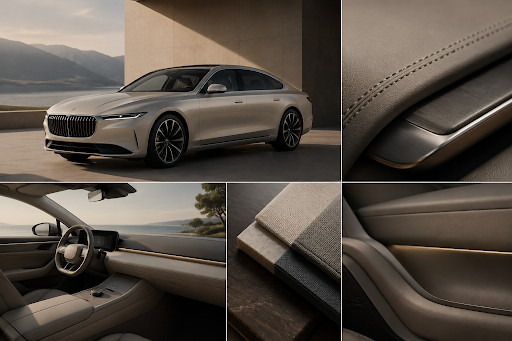
Luxury in the automotive world has traditionally been associated with visibility. Chrome-heavy grilles, aggressive body kits, oversized badges, and lavish interiors once defined what it meant for a car to feel premium. Yet over the last decade, a quieter philosophy has emerged — one that values restraint over spectacle.
Today’s most desirable premium vehicles are increasingly defined not by how loudly they announce themselves, but by how subtly they communicate quality. This shift towards “quiet luxury” reflects broader cultural changes in fashion, architecture, technology, and consumer behaviour, where understatement has become a marker of confidence and sophistication.
For modern motorists, luxury is no longer about excess. It is about refinement, cohesion, and thoughtful design.
Moving Away From Visual Excess
The rise of quiet luxury mirrors a wider change in consumer taste. In fashion, heavily branded products have gradually given way to minimalist tailoring, muted colour palettes, and discreet craftsmanship. Automotive design has followed a similar trajectory.
Many premium manufacturers are reducing unnecessary styling flourishes in favour of cleaner silhouettes and more balanced proportions. Sharp creases and exaggerated vents are being replaced by smoother surfaces and simplified body lines. The emphasis has shifted towards elegance rather than aggression.
Brands such as Volvo have long embraced restrained Scandinavian design, but the philosophy is now visible across the industry. Even traditionally performance-focused marques are softening their visual language to create vehicles that feel timeless rather than attention-seeking.
This is particularly noticeable in the electric vehicle market. Without the packaging constraints of large combustion engines, designers have more freedom to create seamless exteriors with fewer interruptions. The result is a cleaner, calmer aesthetic that aligns naturally with quiet luxury principles.
Interiors Designed Around Calmness
Perhaps the most obvious transformation can be found inside the cabin.
Modern luxury interiors are becoming less cluttered and more architectural. Physical buttons are disappearing, dashboard layouts are becoming increasingly horizontal, and materials are chosen for texture and tactile quality rather than visual extravagance.
Large infotainment displays still dominate many premium cabins, but the best implementations integrate technology discreetly. Screens are hidden behind glass panels, ambient lighting is subtle rather than theatrical, and controls are simplified to reduce cognitive overload while driving.
Manufacturers are also paying closer attention to sensory experiences. Acoustic glass, noise-cancelling systems, and carefully tuned cabin insulation contribute to an atmosphere of calmness that many buyers now value more highly than outright performance statistics.
This reflects a broader understanding that luxury is emotional as much as material. A quiet, composed cabin can feel more premium than one overloaded with visible technology and decorative trim.
The Influence of Technology Minimalism
Consumer technology has had a major influence on modern automotive aesthetics.
Over the last fifteen years, products from companies like Apple helped normalise minimalist industrial design. Clean interfaces, hidden functionality, and intuitive interaction became associated with premium experiences.
Automotive designers have increasingly adopted similar ideas. Features that once required multiple physical switches can now operate through simplified interfaces or voice controls. Wireless integration has removed visual clutter from cables and connectors, while software updates allow vehicles to evolve without changing their physical design.
Importantly, quiet luxury in automotive design is not anti-technology. Instead, it prioritises invisible technology — systems that work seamlessly in the background without constantly demanding attention.
This approach contrasts sharply with earlier luxury trends where visible complexity itself was often treated as a status symbol.
Why Buyers Are Responding to Understatement
The appeal of quiet luxury is partly cultural and partly psychological.
In an era shaped by social media, overt displays of wealth can feel increasingly performative. Many affluent consumers now prefer products that communicate taste through subtlety rather than conspicuous branding. The automotive sector reflects this same shift.
A restrained vehicle design can project confidence precisely because it does not need to compete visually for attention. This is particularly attractive to younger premium buyers who often prioritise authenticity and design integrity over traditional status symbols.
There is also a growing appreciation for longevity. Minimalist designs tend to age more gracefully than heavily stylised vehicles tied to short-lived trends. As ownership cycles extend and sustainability becomes a more important consideration, timelessness has become commercially valuable.
This helps explain why muted paint finishes, monochromatic interiors, and subtle detailing are increasingly popular across luxury segments.
Personalisation Within Restraint
Interestingly, the rise of quiet luxury has not reduced interest in vehicle personalisation. Instead, it has changed the way motorists customise their cars.
Rather than dramatic visual modifications, many drivers now focus on details that feel integrated and intentional. Subtle wheel finishes, tailored interiors, carefully selected colour combinations, and discreet exterior changes are becoming more common than overt aftermarket styling.
Even personalised registrations often follow this more restrained approach. Instead of novelty combinations designed purely for attention, many motorists choose plates that feel elegant, minimal, or quietly distinctive. Companies such as Plates Express have seen growing interest from drivers who view vehicle identity as part of a broader lifestyle aesthetic rather than a statement of excess.
The emphasis is increasingly on coherence —
ensuring every element of a vehicle feels considered rather than attention-seeking.
Sustainability and Lasting Design
Quiet luxury also aligns naturally with sustainability trends within the automotive industry.
As environmental awareness grows, overt consumption is becoming less culturally aspirational. Buyers are increasingly drawn towards products designed for durability and long-term ownership rather than rapid replacement cycles.
In automotive design, this encourages interiors built around lasting materials rather than trend-driven finishes. Neutral colour palettes, high-quality textiles, and simplified layouts tend to remain visually relevant for longer periods.
Electric vehicles have accelerated this movement further. Many EV manufacturers position sustainability and minimalism together as part of a single design philosophy. Interiors often feature recycled materials, open spaces, and reduced ornamentation, reinforcing the connection between simplicity and responsible consumption.
The result is a form of luxury centred less on abundance and more on intentionality.
A New Definition of Automotive Prestige
Quiet luxury does not represent the disappearance of prestige within the automotive world. Instead, it signals a redefinition of what prestige looks like.
For decades, luxury vehicles relied heavily on visual dominance and conspicuous features. Today, the most admired designs are often those that appear effortless — vehicles where craftsmanship, technology, and materials work together without demanding constant recognition.
This evolution reflects broader cultural changes in how consumers perceive status, identity, and quality. In many ways, understated design has become the ultimate expression of confidence because it assumes the product does not need to prove itself loudly.
As automotive design continues evolving alongside digital technology and shifting consumer values, quiet luxury is likely to become even more influential. The future of premium motoring may not be louder or more extravagant. It may simply be calmer, cleaner, and more intelligently restrained.